
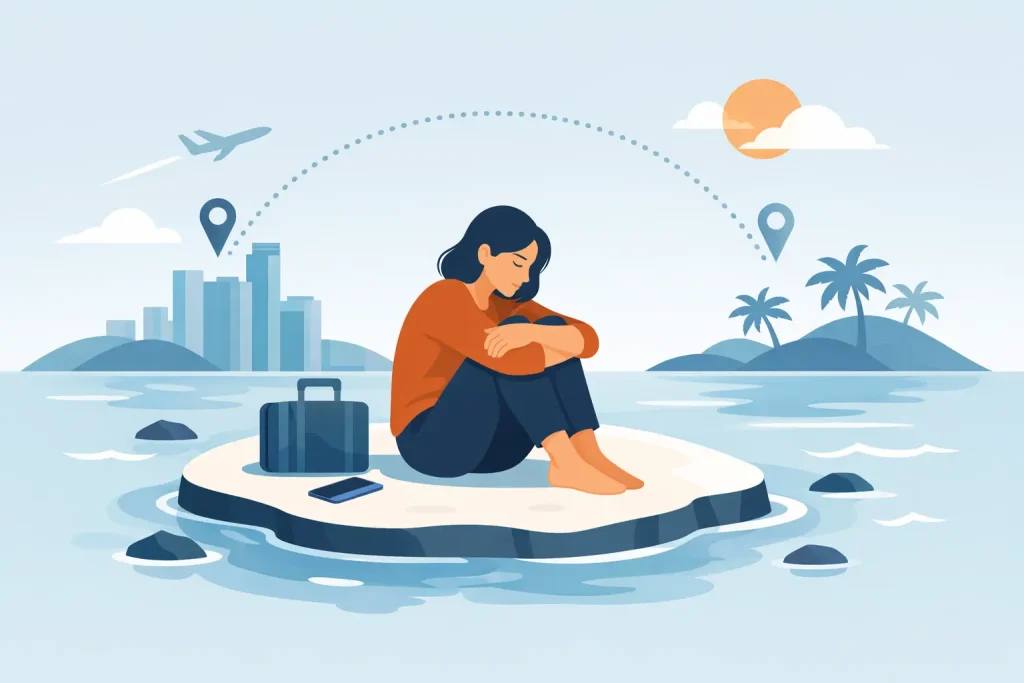
The loneliness often hits at ordinary moments. You finish work, put the kettle on, and realise there is no one you can ring without checking the time difference first. Or you are surrounded by people in a busy city and still feel strangely unseen. Feeling isolated as an expat can be deeply unsettling because from the outside, your life may look exciting, brave and full of possibility. On the inside, it can feel flat, disconnected and far harder than you expected.
If that is where you are right now, there is nothing wrong with you. Isolation is not a sign that you are weak, ungrateful or failing to adapt properly. More often, it is a very human response to disrupted routines, lost familiarity and the pressure of rebuilding a life from scratch.
Why feeling isolated as an expat cuts so deeply
When you move country, you do not just change your postcode. You lose hundreds of tiny anchors that used to help you feel steady. The barista who knew your order, the friend who understood your humour without explanation, the colleague who could read your mood, even the route to your local shop – these things matter more than we tend to realise until they are gone.
As an expat, you may also be carrying an invisible emotional load. You are adjusting to a different culture, perhaps a different language, new systems, fresh expectations and a social code you have not quite learned yet. That takes energy. Even positive change can be exhausting when your nervous system is working overtime to process it.
There is another layer too. Many expats feel they should be coping better because this was their choice. That thought can become a trap. You tell yourself you ought to be grateful, more adventurous, more sociable, more resilient. Instead of asking for support, you judge yourself for needing it.
The result is often a painful mix of loneliness and self-criticism. That combination can quietly chip away at confidence.
The signs are not always obvious
Isolation does not always look like sitting alone and crying, though sometimes it does. It can show up in subtler ways. You may feel less motivated, more irritable, oddly numb, or unusually sensitive to small setbacks. You might avoid making plans because it feels too much effort, then feel worse because your world has become smaller.
For some people, isolation starts to affect work. Concentration drops. Decisions feel harder. A simple email can feel disproportionately draining. For others, it spills into relationships. You may rely heavily on one person for all emotional support, which can create pressure and resentment, especially if your partner is also adjusting.
If you have children, the experience can be even more layered. You may be managing your own sense of loss while trying to help them settle, make friends and feel secure. That can leave very little room for your own emotions, which then tend to surface later as overwhelm or exhaustion.
What makes expat loneliness harder than ordinary loneliness
Loneliness at home is painful. Loneliness abroad can feel disorientating as well. You may not know where to go, how to meet people naturally, or what is culturally acceptable in friendships. Even when you do meet kind people, building genuine closeness takes time.
That is one of the hardest truths to accept. Belonging is rarely immediate. Some people settle quickly, while others take much longer. It depends on personality, language confidence, family set-up, work patterns and whether the move itself was wanted, necessary or complicated by stress.
Social media does not help. It can make it seem as though every other expat has instantly found their crowd, their favourite café, their new routine and a perfect weekend life. Usually, you are seeing the polished version. Many people who look settled are still struggling quietly.
How to respond when you are feeling isolated as an expat
The first step is to stop treating your feelings like a personal failure. Isolation is a signal, not a verdict. It tells you that you need more connection, more structure, more support or more emotional honesty than you currently have.
Start with rhythm before intensity. Many expats think the answer is to become more outgoing overnight, but that can backfire if you already feel emotionally stretched. It is often more effective to build small points of contact into your week. Go to the same café on the same morning. Join one regular class. Work from the same shared space once a week if that is possible. Familiarity creates a sense of safety, and safety makes connection easier.
Next, be more specific about the kind of loneliness you feel. Are you missing emotional intimacy, practical support, professional identity or simple everyday company? These are not the same problem. If what you miss is deep conversation, attending random networking events may leave you feeling emptier. If what you miss is routine and structure, endlessly messaging friends back home may soothe you briefly without helping you build a life where you are.
It also helps to lower the pressure around friendship. Not every connection needs to become a best friend relationship. Some people will be companions for a season, a school-gate chat, a walking partner, someone to share a coffee with after language class. These lighter ties matter. They often become the bridge to stronger belonging.
Practical ways to rebuild connection abroad
One of the most useful shifts is moving from waiting to participating. When you feel low, it is natural to hope someone will notice, invite you in and make things easier. Sometimes that happens. Often, it does not. Many adults are busy, shy or unsure themselves.
Participation means choosing visible, repeatable spaces where people can get to know you gradually. That might be a local exercise group, volunteering, a hobby club, a parents’ group, a faith community or a professional circle. The best option is usually not the most impressive one. It is the one you can realistically attend consistently.
You also need honest contact with people who understand the expat experience. Friends and family at home may care deeply, but they do not always grasp the strange grief of building a life in a place that still does not quite feel like yours. Speaking with someone who understands that tension can be a relief in itself.
At the same time, try not to build your whole world only around other expats. That can feel comforting at first, but it may keep you suspended between two lives rather than helping you root into one. A balance tends to work best.
When mindset work matters, and when it is not enough
A lot of advice about expat loneliness focuses on positive thinking. Some mindset work is useful. The stories you tell yourself do shape your experience. If you constantly repeat, nobody here will ever understand me, your behaviour may become more guarded and withdrawn.
But mindset is not magic. If you are isolated, overwhelmed and emotionally depleted, you may need more than a pep talk. You may need support, structure and a place to process what the move has stirred up in you. Sometimes the issue is not just the country change. The move has simply exposed old patterns around self-worth, belonging, boundaries or confidence.
That is where coaching can be especially valuable. A good coaching relationship gives you space to untangle what is environmental, what is emotional and what needs practical action. It helps you move from vague heaviness to clear next steps. At Life-coach-me, this is often where real change begins for expats – not by forcing confidence, but by rebuilding it steadily through self-awareness and action.
Give yourself permission to build slowly
There is no prize for adapting fastest. Some months abroad feel expansive and full of discovery. Others feel lonely, frustrating and uncertain. Both can be true in the same chapter.
If you are feeling isolated as an expat, try to measure progress differently. Not by whether you already feel completely at home, but by whether your days are becoming a little more connected, a little more grounded, a little more like your life rather than a waiting room.
Belonging usually arrives quietly. It shows up in recognition, in routine, in one or two safe people, in the moment you stop translating every experience through what you have lost. Until then, be gentle with yourself. You are not behind. You are building something real, and real things take time.